
How scissor lift works
Mechanical Design, Calculations and CAD Projects
Scissor lifts are widely used in workshops, warehouses and industrial environments to safely raise heavy loads to a desired height. Despite their simple appearance, scissor lift mechanisms involve precise geometry, force distribution and structural design.
This guide explains how a scissor lift works from an engineering perspective, including the mechanical principle, force calculations and key design considerations. If you are planning to build your own lifting system, you can also explore complete ready-to-build CAD projects that include full 3D models, 2D drawings and BOM.
Scissor Lift Mechanism Explained
A scissor lift works using a system of linked, folding supports arranged in a crisscross “X” pattern. When the mechanism expands, the platform rises vertically. When it contracts, the platform lowers.
The motion is typically driven by a hydraulic cylinder, screw mechanism or electric actuator. The key idea is that a horizontal force applied at the base is converted into vertical lifting motion.
Mechanical Principle Behind a Scissor Lift
The scissor lift mechanism is based on a simple geometric relationship. As the angle between the arms increases, the vertical height increases while the required lifting force decreases.
At low heights, the mechanism requires significantly higher force because the angle between arms is small. This is why scissor lifts are most heavily loaded at the beginning of the lifting cycle.
From an engineering standpoint, this creates a non-linear force curve that must be considered during design and actuator selection.
Force and Load Calculations
Designing a scissor lift requires understanding how forces are distributed across the mechanism. The actuator force depends on:
- Load weight
- Lift height
- Number of scissor stages
- Geometry of the arms
- Position of the actuator
For example, a 1000 kg scissor lift at low height may require several times the load force due to unfavorable geometry. This is why proper calculation of actuator size and structure strength is critical.
If you want to skip manual calculations, you can use engineering-ready solutions such as scissor lift CAD projects with calculation support.
Main Components of a Scissor Lift
- Scissor arms (steel structural elements)
- Pivot joints and pins
- Base frame
- Top platform
- Actuator (hydraulic cylinder or screw)
- Guide rollers or sliders
Each component must be designed for both static and dynamic loads. Special attention should be paid to joints and welds, as these are critical stress points in the structure.
Applications of Scissor Lifts in Workshops
Scissor lifts are commonly used in mechanical workshops and industrial environments for:
- Lifting heavy parts
- Assembly operations
- Material handling
- Ergonomic work positioning
They are especially useful in fabrication environments where flexibility and space efficiency are important.
Build Your Own Scissor Lift
Designing a scissor lift from scratch requires time, calculations and testing. Many engineers and workshop builders choose to start from proven CAD designs instead of building everything from zero.
Papacad provides complete engineering documentation for scissor lift projects, including:
- 3D CAD assemblies (Inventor / STEP)
- 2D production drawings (DWG + PDF)
- Bill of materials (BOM)
- Engineering-ready structure
👉 Explore available designs:
Scissor Lift CAD Projects
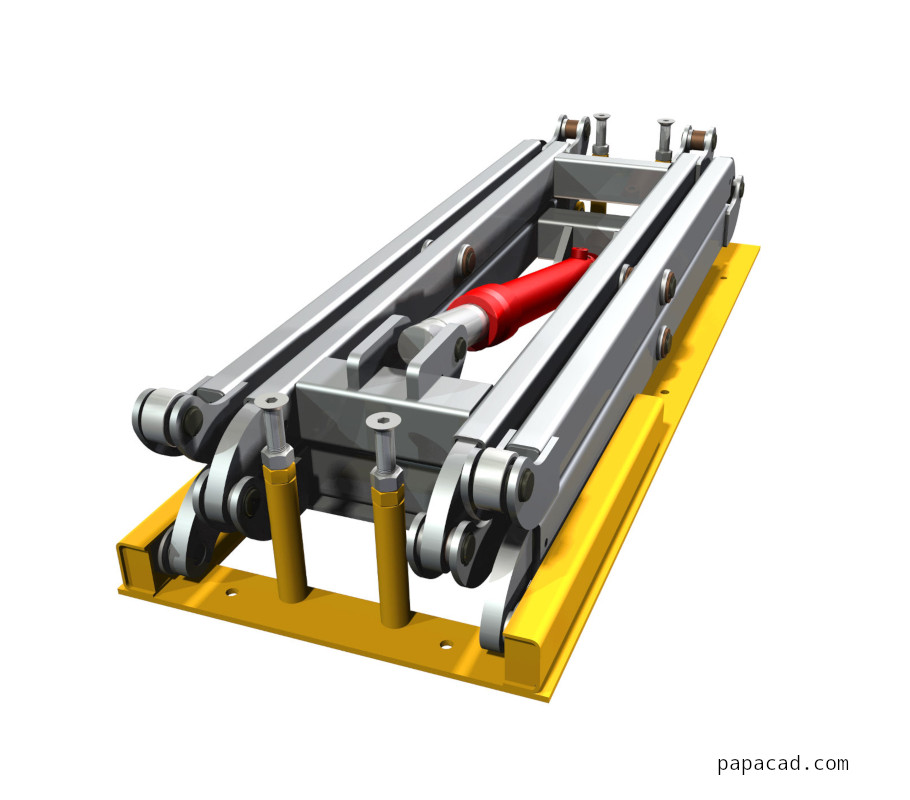
wo Stage Scissor lift CAD design
3D & 2D Complete Project to buy
From 19$
One Stage 500kg Scissor lift CAD design
3D & 2D Complete Project to buy
From $14
One stagge 1200kg Scissor table lifter CAD design with xls calculator
3D & 2D Complete Project to buy
From $15Explore More Mechanical CAD Projects
If you are interested in building your own machines, you can explore a wider range of engineering designs including hydraulic presses, lifting systems and welding fixtures.
👉 Browse the full collection here:
ALL PAPACAD CAD PROJECTS
FAQ – Scissor Lift Design
How does a scissor lift convert horizontal motion into vertical lifting?
The scissor mechanism uses pivoting arms arranged in an “X” shape. As the actuator pushes horizontally, the arms expand vertically.
Why is more force required at the beginning of the lift?
At low angles, the mechanical advantage is poor, requiring higher force to initiate lifting.
What material is used for scissor lift structures?
Typically structural steel profiles are used, designed based on load and safety requirements.
Can I build a scissor lift myself?
Yes, but it requires proper design, calculations and fabrication skills. Using a ready CAD project significantly reduces risk and time.