
Welding Positioner Torque Calculation – Engineering Guide
How to Calculate Torque for a Welding Positioner
Welding positioners are widely used in fabrication shops to rotate steel structures, pipes and welded assemblies during production.
A properly designed rotary welding table improves:
- weld quality
- operator ergonomics
- productivity
- repeatability
The most important engineering parameter in a welding positioner is rotational torque.
Incorrect torque calculations lead to:
- motor overload
- unstable rotation
- vibration
- gearbox damage
- positioning problems
What Determines Welding Positioner Torque?
Required torque depends mainly on:
- workpiece mass
- center of gravity offset
- rotational acceleration
- friction
- table diameter
- gearbox efficiency
Basic Torque Formula
T = F × r
Where:
- T = torque [Nm]
- F = force [N]
- r = radius [m]
For rotating systems:
T = m × g × r
Where:
- m = mass [kg]
- g = gravity [N*m/s2]
- r = center of gravity offset [m]
Example Calculation
Assumptions:
- workpiece mass = 300 kg
- center offset = 180 mm
Step 1:
F = 300 × 9.81 [N]
F ≈ 2943 [N]
Step 2:
T = 2943 [N] × 0.18 [m]
T ≈ 529 [Nm]
This is only static torque.
Real systems require higher values because of:
- acceleration
- imbalance
- shock loading
- welding conditions
Gearbox Selection
The gearbox must handle:
- peak torque
- continuous torque
- radial loads
- axial loads
Worm gearboxes are commonly used because they provide:
- high reduction ratio
- compact design
- self-locking capability
Common Design Mistakes
Ignoring center offset
Even small eccentricity dramatically increases required torque.
Undersized bearings
Positioners experience large combined loads.
No dynamic safety factor
Real welding conditions are not ideal.
Recommended Safety Factors
Typical engineering practice:
- static systems → 1.5
- industrial systems → 2.0
- dynamic heavy systems → 2.5+
CAD Welding Positioner Projects
Professional welding positioner CAD projects may include:
- full 3D assemblies
- rotary table geometry
- gearbox mounting
- motor positioning
- welding fixture systems
- engineering calculations

300kg Welding Positioner with electric drive
3D & 2D Complete Project to buy
From 19$
Welding Kant Twist Clamp CAD design
3D & 2D Complete Project to buy
From $6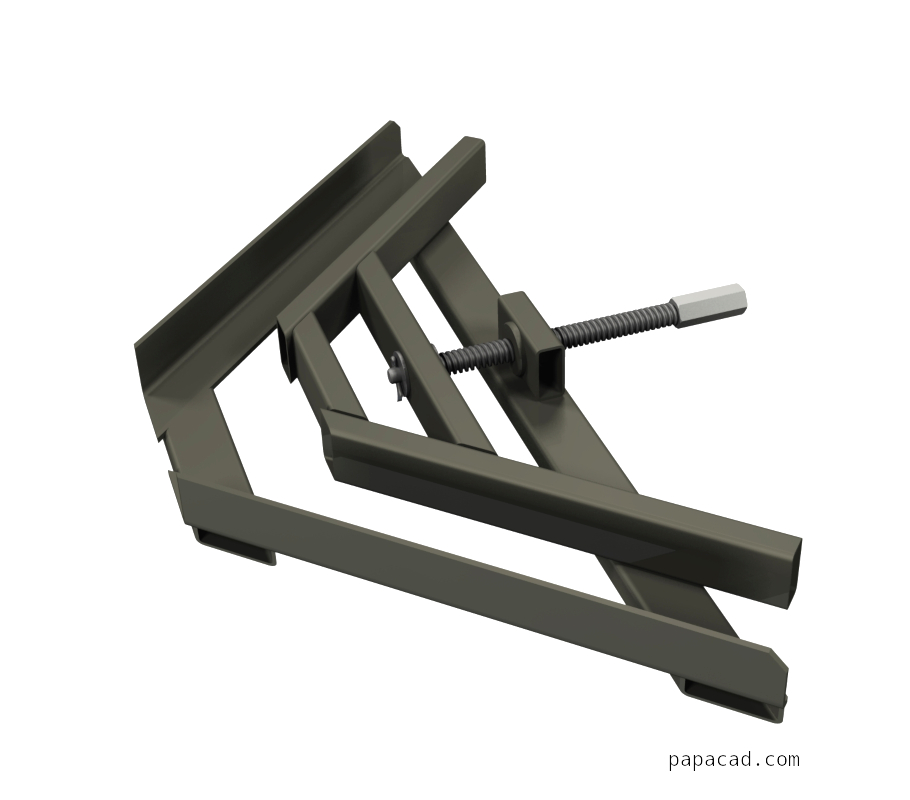
Welding Clamp 90deg Angle – CAD design
3D & 2D Complete Project to buy
From $5Final Thoughts
Welding positioners are relatively compact machines, but the torque requirements can become very large when heavy or eccentric parts are rotated.
Correct torque calculations are essential for:
- smooth rotation
- long gearbox life
- accurate positioning
- operator safety